

GJEPC Calls for a Simpler Approach to Gold Monetisation at Bombay Chamber Gold Summit
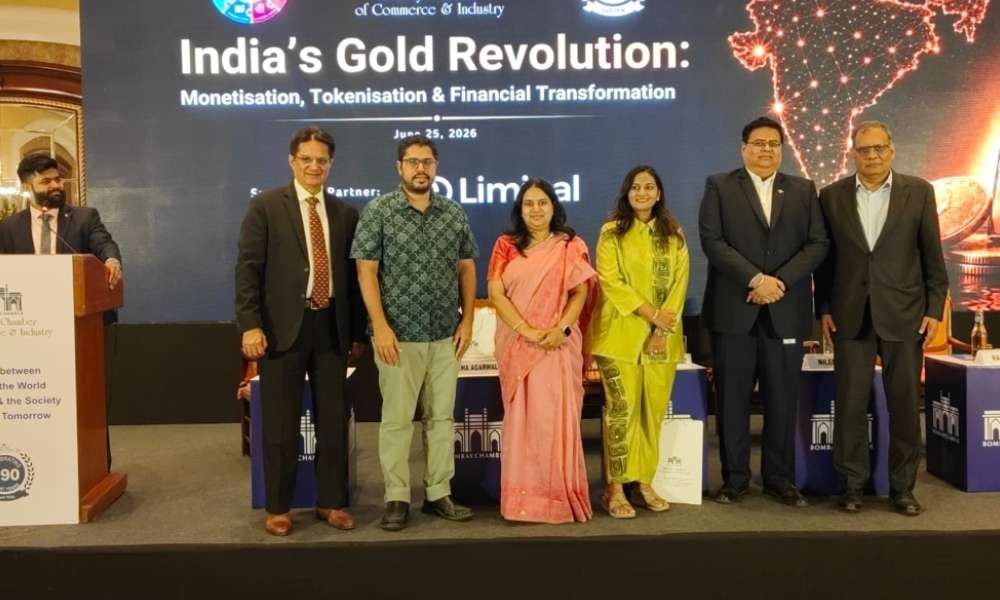
India’s efforts to monetise household gold must prioritise simplicity, trust and ease of access to unlock the country’s vast idle gold reserves, said Khushboo Ranawat, Regional Chairperson – West and Member – National Exhibitions, GJEPC, during a panel discussion at the seminar ‘India’s Gold Revolution: Monetisation, Tokenisation & Financial Transformation’, organised by the Bombay Chamber of Commerce & Industry in Mumbai.
Ranawat participated in the panel discussion titled “Building India’s Gold Monetisation Marketplace”, moderated by Neil Borate, Editor-in-Chief of The Federal’s fintech platform, The Fynprint. The panel also included Richa Agarwal, Chief General Manager, SEBI; Ramakrishnan Padmanabhan, General Manager, Department of Metals & Commodities, IFSCA; Nilesh Lodaya, Chief Business Officer, CDSL; Rajnish Gupta, Partner, Tax and Economic Policy Group, EY India; and Gunveer Singh, Executive Director, Department of Payment & Settlement Systems, RBI. The discussion focused on integrating household gold into the formal financial ecosystem, strengthening India’s gold monetisation framework and reducing reliance on imported gold.
Highlighting the challenge of dormant household gold, Ranawat encouraged consumers to identify jewellery that has remained unused for years and explore formal monetisation avenues such as the Gold Monetisation Scheme and gold deposit products.
“The issue is not that Indians are reluctant to use their gold as a financial asset. Millions already pledge gold to secure loans when required. The real need is to create monetisation products that are as simple, reliable and convenient as gold loans. Once people begin viewing gold as a productive financial asset rather than something locked away, participation will naturally grow,” she said.
Commenting on the limited success of the Gold Monetisation Scheme—which has mobilised fewer than 30 tonnes of gold despite an estimated 25,000 tonnes held by Indian households—Ranawat noted that the requirement for melting jewellery and conducting purity assessments has discouraged participation, especially for heirloom and family jewellery.
She also pointed out that a large portion of India’s privately held gold is in the form of bars and coins, presenting a significant opportunity for future monetisation initiatives.
“The gold loan industry offers the best example. Households are willing to bring their gold into the formal financial system when the process is convenient and trustworthy. Going forward, monetisation programmes should leverage the extensive networks of NBFCs, banks and the organised gold sector. If we can match the ease of obtaining a gold loan while providing attractive incentives, India can unlock substantial domestic gold resources,” Ranawat added.
The seminar brought together regulators, market infrastructure institutions and industry leaders to deliberate on policy reforms, electronic gold receipts, tokenisation and the development of a modern digital gold ecosystem. The event also featured speakers including Praveen Rai, MD & CEO of MCX, former SEBI Executive Director Pramod Rao, along with senior representatives from SEBI, IFSCA, RBI, CDSL and NSDL.