

Commerce Secretary Rajesh Agrawal Unveils 2040 Roadmap to Achieve USD 100 Billion Gems & Jewellery Exports
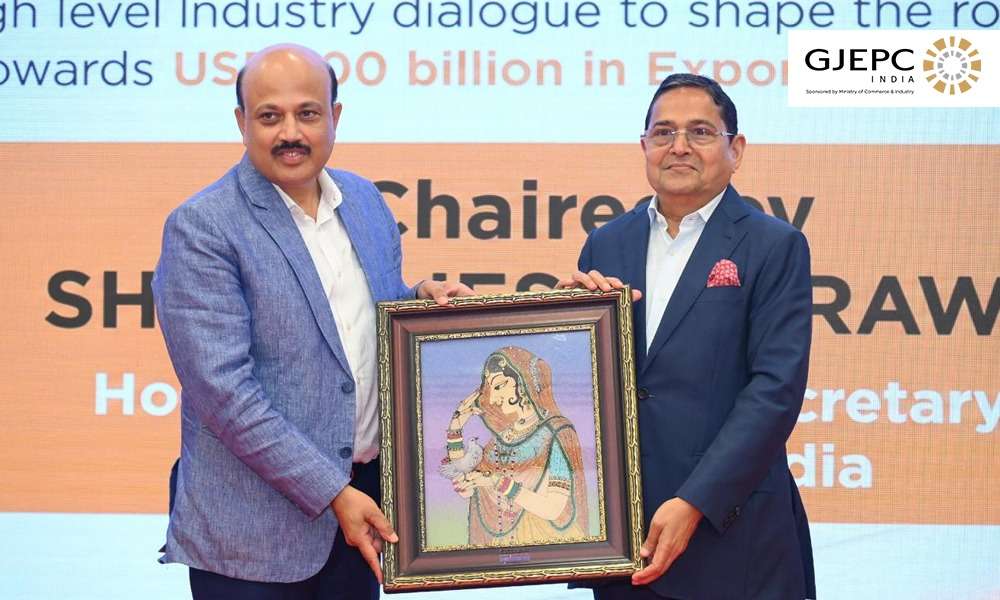
India’s gems and jewellery sector has set an ambitious target of reaching USD 100 billion in exports by 2040, with innovation, design, value addition and global branding identified as key drivers of growth.
The Department of Commerce, in collaboration with the Gem & Jewellery Export Promotion Council (GJEPC), organised the ‘Chintan Shivir – 2040 Roadmap for Gems & Jewellery’, bringing together senior government officials and industry leaders to formulate a strategic roadmap for the sector. The plan aims to increase exports from approximately USD 28 billion in 2025-26 to USD 100 billion by 2040. By then, the sector is expected to contribute around 1.2% to India’s GDP and account for nearly 14% of the country’s merchandise exports.
Speaking about the outcomes of the Chintan Shivir, Commerce Secretary, Government of India, Shri Rajesh Agrawal, said that India’s journey from approximately USD 29 billion to USD 100 billion in exports would depend on developing an ecosystem centred on innovation, design leadership, value addition and trust.
He highlighted that India’s greatest advantage is not its access to gold, silver or rough diamonds, but its large pool of skilled artisans and craftsmen. According to him, greater economic value can be created by focusing on design, innovation and international branding, rather than relying heavily on low-margin OEM manufacturing. He also stressed the importance of strengthening collaboration between educational institutions and the industry through academic incubators that can address practical industry challenges.
Shri Agrawal also called for greater investment in human capital and skill development, while making careers in craftsmanship more aspirational for younger generations. He encouraged the adoption of emerging technologies such as Artificial Intelligence and 3D printing to enable product differentiation and innovation.
He further emphasised the importance of incorporating India’s heritage, culture and storytelling into jewellery design to enhance the country’s soft power. Building transparent, technology-enabled trust networks across domestic and international markets, encouraging greater risk-taking, mentoring young talent and preparing the industry for future challenges were also identified as essential to creating resilient supply chains and globally competitive Indian brands in line with the Viksit Bharat 2047 vision.
Organised under the guidance of Shri Piyush Goyal, Minister of Commerce and Industry, the Chintan Shivir placed value addition at the centre of its discussions. The focus was on increasing exports of finished, design-led and branded jewellery, strengthening manufacturing capabilities, expanding market access and establishing ‘Crafted in India’ jewellery as a globally recognised proposition.
Shri Lav Agarwal, Director General, DGFT, said India has already built a strong position in the global gems and jewellery trade and must now move further up the value chain. He emphasised positioning India as a global destination for design and value-added jewellery, while adopting a mission-driven approach in which the government and industry work together to support emerging exporters and create the right ecosystem for global growth.
Shri Kirit Bhansali, Chairman, GJEPC, said the industry is at a crucial stage, supported by developments such as new Free Trade Agreements, a 15-year tax exemption on rough diamond sales through Special Notified Zones and increased support for MSMEs. He noted that the next phase of growth should focus on accelerating value addition, expanding finished jewellery exports and leveraging India’s world-class craftsmanship and manufacturing expertise.
He added that achieving the USD 100 billion export target by 2040 would require coordinated efforts between government and industry to access new markets, scale MSMEs and establish a distinctive global identity for Indian jewellery.
The discussions also examined an estimated USD 128 billion addressable market across the midstream and downstream segments, highlighting opportunities for India to strengthen its position in high-value categories. Emerging areas including the LGD+ ecosystem, gold mining and refining were also discussed as potential growth avenues.
The Chintan Shivir was organised around five key missions, each explored through dedicated breakout sessions led jointly by senior government representatives and industry leaders:
Mission 1 — Global Market Access
Led by Shri Lav Agarwal, Director General, DGFT, this mission focused on leveraging India’s expanding FTA network and increasing the country’s share of global jewellery consumption.
Mission 2 — MSME Scale-Up
Chaired by Shri R.K. Rai, Additional Development Commissioner, Ministry of MSME, with Shri Sristiraj Ambastha, CMD, ECGC, as Co-Chair, this mission addressed ways to help MSMEs—the backbone of the sector—grow through improved access to finance, technology and international markets.
Mission 3 — Export-Import Fast Track
Led by Shri Shiv Kumar Sharma, Director General, DGEP, the mission explored measures to establish faster, simpler and more predictable cross-border trade procedures.
Mission 4 — Crafted by India
This mission focused on enhancing the global identity and value of Indian jewellery through stronger design capabilities, intellectual property and international branding.
Mission 5 — Next-Generation Talent & Design
The final mission concentrated on developing the skills, design expertise and talent pipeline needed to support the industry’s growth towards the USD 100 billion export ambition.
The Chintan Shivir concluded with a commitment to strengthen India’s leadership in established categories such as natural diamonds, while also capturing emerging opportunities across the global jewellery value chain.
The proposed roadmap targets doubling manufacturing output to around ₹15 lakh crore and increasing the sector’s overall economic value to nearly ₹60 lakh crore. It also seeks to transform India from an OEM-focused manufacturing base into a global ODM (Original Design Manufacturing) and jewellery branding powerhouse.
The event brought together senior government officials and industry representatives to discuss strategies for strengthening India’s position in the global gems and jewellery value chain. Key participants included Shri Lav Agarwal, Shri Shiv Kumar Sharma, Shri Dnyaneshwar Patil, Shri Saket Kumar, Shri R.K. Mishra, Shri Sristiraj Ambastha, Dr. Tariq Thomas, Shri R.K. Rai, Dr. Shyam Kumar Barik and Shri Praveen Kumar.
Representing GJEPC were Shri Kirit Bhansali, Chairman; Shri Shaunak Parikh, Vice Chairman; Shri Sabyasachi Ray, Executive Director, along with members of the Committee of Administration.
The roadmap positions the gems and jewellery industry as a significant contributor to India’s Viksit Bharat 2047 ambition, with innovation, design, technology, talent development and global branding expected to drive the sector’s transformation over the coming years.