

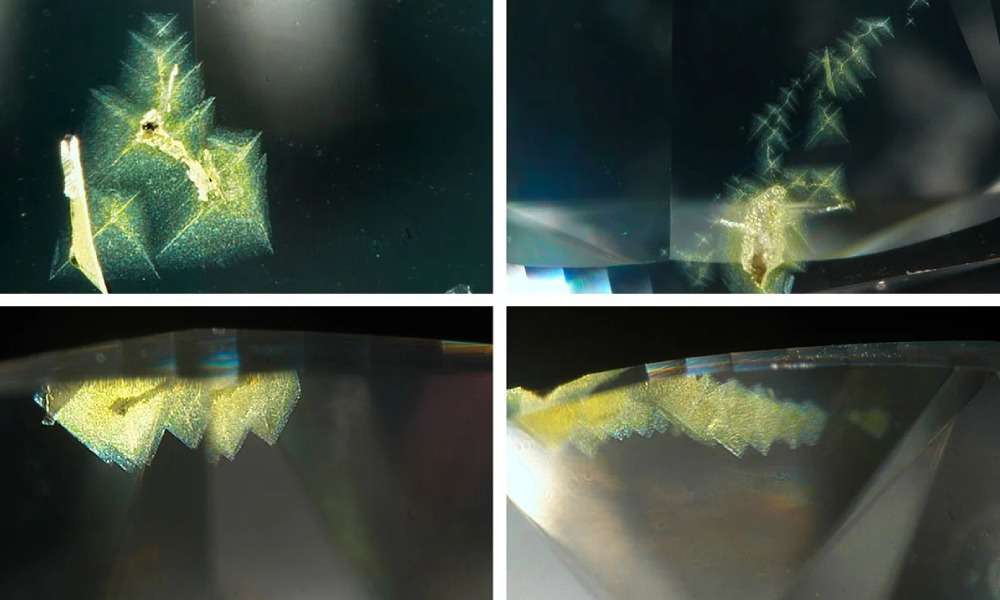
The Gemological Institute of America (GIA) recently examined an extraordinarily unusual diamond whose features proved difficult to interpret. The 2.50-carat round brilliant, assessed at GIA’s Carlsbad, California lab, exhibited striking star-shaped inclusions that left researchers unsure of their formation.
Researchers observed “multiple irregularly placed yellow regions made up of stacked clouds showing four-point star patterns near the girdle.” These clouds—clusters of microscopic inclusions—contained a central concentration of deeper yellow particles arranged in a cross-like shape. When viewed from a different angle, the effect resembled a series of overlapping bright-yellow triangles, prompting GIA scientists to undertake a detailed study.
Early observations showed the diamond emitted blue fluorescence under long-wave UV light, while the yellow clouded areas displayed faint yellow fluorescence under deep-UV imaging. Tests also detected hydrogen-related defects, which typically relate to brown or green tints. However, these did not account for the strong yellow coloring, which is usually caused by cape defects, H3 centers, isolated nitrogen atoms (C-centers), or a 480-nanometer absorption band.
To understand the anomaly, the GIA conducted photoluminescence spectroscopy on both the yellow patches and the surrounding diamond material. No H3 features or relevant absorption-band activity were found. The only significant discovery was a nitrogen-vacancy center present exclusively in the intensely yellow regions, indicating that the color may originate from C-centers limited to specific surface zones.
The team briefly considered whether this case was similar to a 2020 report involving a near-colorless diamond that developed a yellow overgrowth later in its growth process. However, the structure and behavior of the micro-inclusion clouds in the current diamond did not match that example.
Ultimately, GIA researchers determined that the cause and formation process of the diamond’s starburst-like inclusions remain a mystery—one that will require additional scientific investigation.