

Reena Ahluwalia’s Winston Red Diamond Artwork Added To The Collection Of The Smithsonian National Museum of Natural History
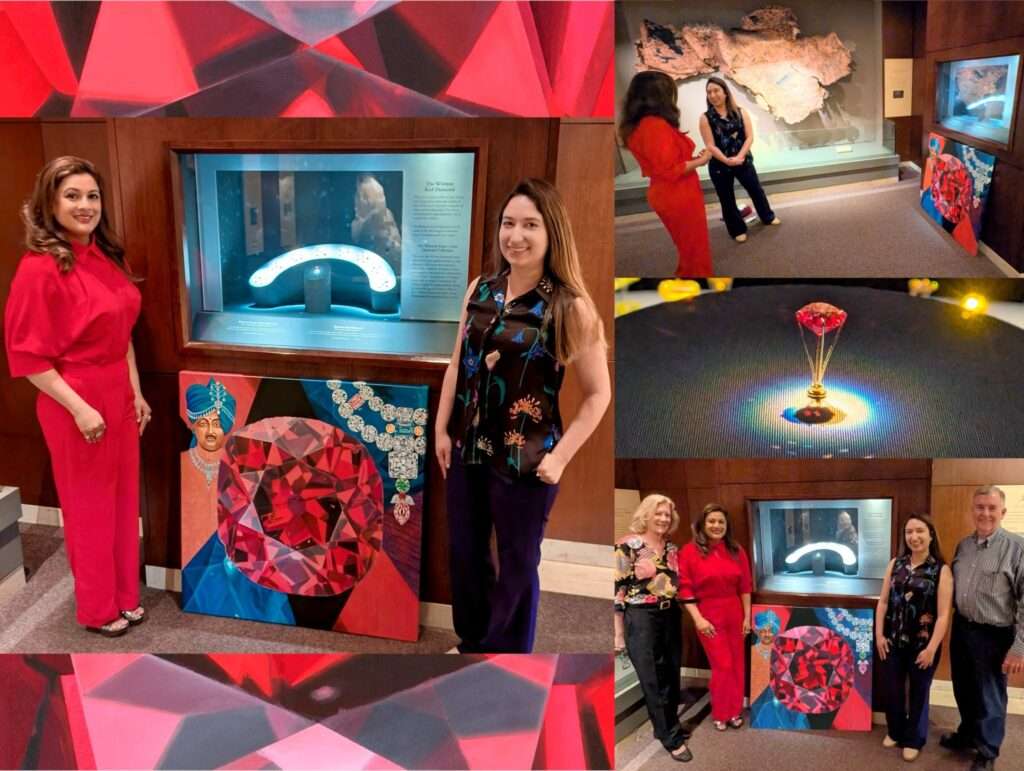
Reena Ahluwalia’s painting, “The Legacy of The Winston Red Diamond,” has officially been accessioned into the Smithsonian National Museum of Natural History. During a ceremony held on May 6 at the Janet Annenberg Hooker Hall of Geology, Gems, and Minerals, Gabriela Farfan, Coralyn W. Whitney Curator of Gems and Minerals, formally accepted the artwork, marking the first time a contemporary painting has entered the National Gem Collection.
The artwork centres around the legendary Winston Red Diamond — one of the rarest diamonds in the world. The 2.33-carat Fancy red old mine brilliant-cut diamond is considered a one-in-25-million natural rarity. It is recognised as the fifth-largest pure Fancy red diamond known to exist and remains the only Fancy red diamond currently displayed for public viewing. In 2023, Ronald Winston, son of famed jeweller Harry Winston, donated the diamond to the Smithsonian.
Ahluwalia’s painting weaves together the diamond’s scientific attributes, historical narrative, and cultural symbolism into a single visual composition. The artwork explores the transformation of the stone from the “Raj Red” to the “Winston Red,” tracing its likely South American origins and its 1938 acquisition by Jacques Cartier for Digvijaysinhji, widely remembered as the “Good Maharaja.” The diamond was later mounted in the celebrated Ceremonial Necklace of Nawanagar, a renowned Cartier creation that went on to inspire the iconic “Toussaint Necklace” recreation. Ronald Winston eventually acquired the diamond from the Maharaja of Jamnagar in the late 1980s.
The painting was inspired by Ronald Winston’s donation and by research led by Dr. Gabriela A. Farfan and her team, published in the Spring 2025 edition of Gemological Institute of America’s Gems & Gemology. The Winston Red’s striking crimson hue is attributed to a precise balance of absorption features, including the 550 nm band linked to plastic deformation and nitrogen-related defects. Through colour, texture, and composition, Ahluwalia interprets these gemological characteristics artistically.
Speaking about the work, Ahluwalia said, “Art endures beyond its physical form as an idea whose meaning transcends time. I chose to paint the Winston Red because I felt a responsibility to narrate its complete story through an artistic perspective. Using the diamond as a philosophical prism, my work views minerals as metaphors for human resilience — formed under pressure, shaped by circumstance, and enduring through adversity.”
Throughout the creative process, Ahluwalia remained in close dialogue with both Ronald Winston and Dr. Gabriela Farfan. The final piece bridges science, nature, history, and art, positioning the diamond as both a geological wonder and a cultural archive.
“Ultimately, this painting serves the diamond’s history and legacy,” Ahluwalia added. “When art serves a greater purpose, its impact becomes as enduring as the diamond itself. This work is my attempt to preserve the intangible heritage of the Winston Red Diamond for future generations and inspire curiosity among gem enthusiasts, historians, mineralogists, and Earth scientists alike.”
As part of Ahluwalia’s Human-Gem Arc series, the artwork stands as a conceptual exploration of endurance, transforming geological pressure into a powerful visual expression of resilience.